Can you buy a flood-risk property at auction?
Buying a flood-risk property at auction can present an opportunity to acquire property at a potentially attractive price, but it is essential to understand the risks before you bid. Properties affected by river, coastal, surface water or groundwater flooding can sometimes offer significant potential, particularly where the price reflects the level of risk. However, insurance, mortgage availability, previous flood history, repair costs and future resale should all form part of your due diligence. In this guide, we look at what buyers should investigate before purchasing a flood-risk property at auction and why careful research is particularly important when buying under auction conditions.
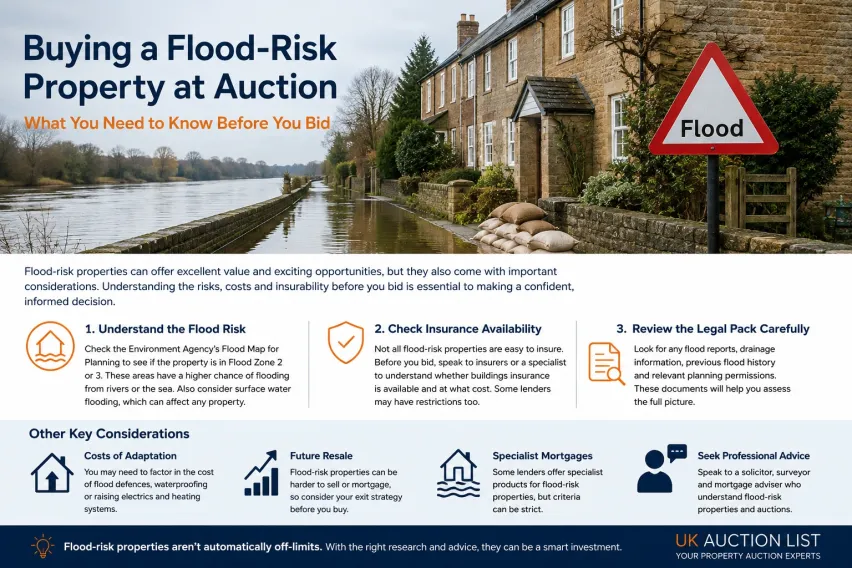
Buying a Flood-Risk Property at Auction
Flood-risk properties can sometimes attract buyers because they are offered at lower prices than comparable properties in areas with little or no known flood risk. For investors, developers and experienced auction buyers, this can create opportunities that may not be available on the conventional property market.
However, a lower purchase price does not necessarily mean a bargain.
Flood risk can affect insurance premiums, mortgage availability, repair and maintenance costs and the property's future resale prospects. When buying at auction, where contracts can become legally binding as soon as the hammer falls, it is particularly important to investigate these issues before bidding.
What does flood risk actually mean?
Flood risk is not limited to properties beside a river.
A property can potentially be affected by:
- River flooding
- Coastal or tidal flooding
- Surface water flooding following heavy rainfall
- Groundwater flooding
- Reservoir flooding
- Drainage or sewer-related flooding
The GOV.UK long-term flood-risk service allows buyers to investigate several of these risks for an area in England, including rivers and the sea, surface water, reservoirs and groundwater where information is available. However, the Government specifically warns that the service does not establish how likely an individual property is to flood.
This is an important distinction.
A property being shown within an area of flood risk does not automatically mean that the building itself has flooded, just as a property outside a particular flood zone should not necessarily be assumed to be completely free from flooding risk.
Check the property's flood-risk information
Before bidding, buyers should investigate the property's location using the relevant official flood-risk information.
For properties in England, the Environment Agency's Flood Map for Planning identifies areas at risk from rivers and the sea. Current classifications include Flood Zone 1, Flood Zone 2 and Flood Zone 3, with Flood Zone 1 representing a less than 0.1% annual probability of flooding from rivers and the sea, while Flood Zone 3 represents a 1% or greater annual probability from rivers or a 0.5% or greater annual probability from the sea.
However, flood zones are primarily planning tools and shouldn't be treated as a complete property-level flood assessment.
For example, surface water flooding can affect properties that aren't obviously close to a river or coastline.
Investigate the property's previous flood history
Past flooding should be one of the most important areas of research before buying.
If a property has previously flooded, try to establish:
- When the flooding occurred
- How often it has happened
- How deep the water reached
- Whether the building itself was affected
- Which parts of the property were damaged
- Whether repairs or flood-resilience work have been carried out
- Whether neighbouring properties have also been affected
- Whether there are local flood defences
- Whether there are known drainage issues
The Environment Agency allows people to request flood-history information for an address or postcode in England, although its records are not comprehensive for every area.
It can also be worth speaking to neighbours or local residents. They may have knowledge of flooding that isn't immediately apparent from property particulars or online mapping.
Read the legal pack carefully
This is particularly important when buying at auction.
The legal pack may contain information relevant to the property's history, title, searches, planning matters and other issues that could affect your decision to bid.
If flood risk is mentioned in the particulars, searches or other documentation, don't simply assume that it is insignificant because the property appears to be in good condition.
Likewise, don't assume that the absence of an obvious reference to flooding means that there is no risk.
If you're unsure about anything in the legal pack, ask your solicitor to investigate it before the auction.
Remember that buying at auction is not the same as making an offer on a property through an estate agent. Once the hammer falls, you may have entered into a legally binding contract, subject to the auction's specific terms.
Can you get insurance on a flood-risk property?
This is one of the most important questions to answer before bidding.
Flood risk can make insurance more difficult or more expensive, and buyers should investigate the availability and cost of buildings and contents insurance before committing to purchase.
Flood Re exists to help eligible householders access affordable flood insurance. However, not every property qualifies. For example, Flood Re's current eligibility criteria include requirements relating to the property's use, Council Tax status and age. Flood Re generally supports qualifying residential properties built before 1 January 2009, while commercial properties and some other categories are excluded.
This is particularly relevant to auction buyers because a property may be:
- A buy-to-let investment
- A holiday home
- Mixed-use
- Commercial
- A development opportunity
- Unoccupied
The insurance position can therefore be quite different from that of a standard owner-occupied house.
Always obtain an insurance quotation before bidding rather than assuming suitable cover will be available afterwards.
Flood Re itself recommends using its eligibility tool and shopping around for suitable cover.
Will a mortgage lender finance a flood-risk property?
Mortgage availability should also be investigated before the auction.
A property with significant flood risk may present additional considerations for lenders and insurers. Even where finance is theoretically available, the lender may require further information or impose conditions.
If you need a mortgage to complete the purchase, speak to your mortgage adviser before bidding and make sure they are aware of the property's flood-risk status.
This is especially important at auction because buyers generally cannot bid first and then assume they will be able to arrange finance afterwards.
If your mortgage falls through after you have exchanged contracts, you could still be legally committed to completing the purchase.
Could flood-risk improvements add value?
Flood risk does not necessarily mean that a property cannot be improved.
Depending on the circumstances, buyers may be able to introduce flood-resistance or flood-resilience measures designed to reduce the potential impact of future flooding.
These might include measures such as:
- Flood doors and barriers
- Raising electrical sockets
- More resilient flooring and wall finishes
- Improved drainage
- Pumps
- Flood-resistant materials
- Measures designed to prevent water entering the property
Flood Re's Build Back Better initiative can, for qualifying claims and policies where the insurer offers it, contribute towards measures that make a property more resistant or resilient to future flooding. Flood Re states that eligible costs can include surveys, flood doors and more flood-resilient materials, subject to the relevant policy and limits.
For an auction buyer, however, the important point is that the cost of any necessary work needs to be included in your calculations before you bid.
Don't forget the cost of future resale
It is easy to concentrate on the purchase price when a property appears to offer a significant discount.
But ask yourself:
Who will buy it from me in the future?
If you intend to renovate and sell, future buyers may have the same concerns about insurance, mortgages and flood history that you have considered yourself.
This doesn't necessarily make the property a bad investment, but it means your exit strategy needs to be realistic.
An experienced investor may be comfortable buying a flood-risk property because they understand the market and have calculated the risks accordingly. A first-time buyer may take a very different view.
Is buying a flood-risk property at auction a good idea?
There is no simple yes or no answer.
A flood-risk property could represent an excellent opportunity if:
- The purchase price properly reflects the risk
- Insurance is available at an acceptable cost
- Mortgage finance is available if required
- Previous flooding has been properly investigated
- Repair or resilience costs have been calculated
- The legal pack has been reviewed
- The buyer understands the potential resale implications
On the other hand, a property can become an expensive mistake if the buyer focuses solely on the guide price without investigating the risks.
The golden rule: do your homework before you bid
Auction properties can move quickly, and it can be tempting to become caught up in the excitement of bidding.
With a flood-risk property, however, research should come before emotion.
Check the flood maps. Investigate the property's history. Read the legal pack. Speak to a solicitor. Obtain an insurance quotation. If you need finance, speak to your mortgage adviser. And make sure you've calculated the cost of any work that may be required.
The Environment Agency's official mapping is an excellent starting point, but it should be treated as one part of your overall due diligence rather than a definitive statement about whether an individual property will flood.
For buyers who understand the risks and price accordingly, flood-risk properties can offer opportunities that are worth investigating.
But, as with any property purchased at auction, the best bargains are found by doing the research before raising your hand to bid.
You May Also Like...